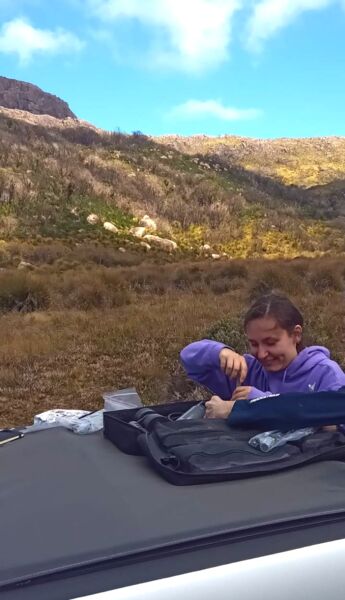
Noémie Poteaux
- First-year PhD student
- 6 to 7 weeks, from early November to mid-December 2026 / 1–2 months
- Source: Chrono-environnement
- Destination: Department of Geochemistry (GEO), Federal University of Fluminense (UFF, Brazilian partner)
- Links with FairCarboN: Workstreams 1 & 2: Land–coastal zone–atmosphere continuum & Coupling of biogeochemical cycles / Project: CarboNium
Summary of the mission
INTERCAMBIO
INTERnational CArbon Monitoring By Interdisciplinary Observations
Temperate mountain peatlands, like tropical peatlands, export a significant proportion of carbon relative to their surface area (tropical peatlands account for 37 per cent of global peatland fluxes, whilst representing only 13 per cent of the world’s peatland area (Rosset et al., 2022), whilst temperate mountain peatlands account for over 40 per cent of carbon emissions despite comprising less than a third of the country’s peatlands (Pinault 2025)). Furthermore, whilst peatlands associated with large-scale catchments are better understood, there is a knowledge gap regarding mountain peatlands, which are often situated at the headwaters of catchments.
This mobility project forms part of my PhD research project ‘PRojetEr: Hydrological and Carbon Dynamics in the Karst and Peatlands of the Jura in the 21st Century’ (PREDHYCKT Jura XXI; 2025–2028), which aims to understand, model and predict the response of hydrological and carbon fluxes to climate change in a temperate mountain climate for these two hydrosystems. This work also forms part of the collaborative project PER TURBERA (Climat AmSud programme, funded by the Ministry of Foreign Affairs, the CNRS and CAPES; 2025–2026), and the operational project CARNAVAL (Carbon Fluxes downstream of peatlands in temperate and tropical mountain contexts; 2025–2026), supported by the SNO Tourbières.
These projects aim to provide an integrated understanding and modelling of the dynamics of carbon exports in peatland ecosystems through a multidisciplinary approach involving the analysis of hydrometeorological factors, the identification of carbon sources, the quantification of carbon fluxes across multiple timescales, and the projection of future trends in these exports under various climate change scenarios. The overall objective of this proposal is to assess the mechanisms governing hydrological carbon exports and the links between carbon and water fluxes in mountain peatlands. The role of the ecosystem’s vertical and lateral complexity, the hydrological behaviour of the catchment, and ongoing and projected climate change will be analysed by incorporating the reactivity of the systems for various Shared Socio-economic Pathways scenarios for the 21st century (ssp245 and ssp585, made available via the Coupled Model Intercomparison Project (CMIP); (Juckes et al, 2020)).
With regard to international scientific collaboration as part of my PhD research, we are considering a partnership with the geochemistry team at the Federal University of Fluminense (UFF), which specialises in the molecular, elemental and isotopic characterisation of organic matter in a sedimentary context. The export of organic and inorganic carbon from two mountain peatland sites will be studied both quantitatively (concentrations and fluxes of different forms of carbon) and qualitatively in temperate (French site) and tropical (Brazilian site) environments. With this in mind, I have already helped to install a fluorescence probe at Frasne (SNO Tourbières site) and carried out a reconnaissance of a site to be equipped in a tropical context (Campo Belo, Itatiaia National Park, Brazil, State of Rio de Janeiro) with the team from the Department of Geochemistry at the UFF, with the aim of establishing a long-term observation site. At the same time, monitoring of electrical conductivity (to determine the concentration of dissolved inorganic carbon), temperature and pH (which influences the speciation of dissolved inorganic carbon) is planned (using CTD and pH sensors). These measurements will be combined with those from piezometers and with meteorological data (precipitation, air temperature, actual evapotranspiration). Finally, following our first field visit in July 2025, a fluorescence probe and a CTD probe are expected to be installed by the end of 2025 at the tropical peatland site.
In this context, the benefits of an international mobility placement are twofold. On the one hand, it would enable me to continue contributing to the establishment of an observatory at the Campo Belo site, making the most of my experience in the field of long-term observatory equipment and data analysis. On the other hand, my PhD research could benefit from the analytical skills and expertise of colleagues in the Department of Geochemistry at the UFF. By combining these two aspects, this mobility project would bring an international perspective to my PhD research, by comparing data collected in a mountainous environment in the northern hemisphere with a high-altitude site in the southern hemisphere. To this end, at the Brazilian and French sites (for which a chronology already exists), peat profile cores will be collected between November 2025 and October 2026 (one core per site) to characterise the quality of the organic matter (C/N ratios, 13C, C29/C33 ratios of alkanes, and identification of sterols) according to its relative age. In parallel, in order to assess the compartments mobilised by carbon export depending on hydrological conditions, monthly to bi-monthly sampling by filtration of organic carbon exported by the peatlands will be carried out over a hydrological year between October 2025 and October 2026. In November/December 2026 (6 weeks), a visit to the UFF will take place to analyse samples from the French and Brazilian sites and to assist with the analysis of the first chronicles acquired at the Brazilian site.
In addition to these two monitoring programmes, we will be building a database of remote-sensing observations (in collaboration with the University of Paraíba in Brazil, through the PER TURBERA project). This approach will enable us to obtain data on a larger scale and at a lower cost than monitoring based solely on fieldwork and probe calibration. Hydrological variables (precipitation, evapotranspiration, soil moisture) derived from satellite data help to estimate groundwater recharge and water levels, whilst biophysical parameters (soil and vegetation indices) enhance the analysis of carbon fluxes through estimates of gross primary production (GPP) and net ecosystem exchange (NEE) across the seasons. The integration of local and satellite observations should enable the production of more robust water and carbon flux models that can be generalised to the year 2100 by incorporating CMIP climate simulations, and which are applicable to other sites in similar contexts.
The mobility programme will thus provide an opportunity for exchange, enabling the comparison of data and the pooling of expertise: the French team’s field expertise and the Brazilian partners’ expertise in geochemical analysis and remote sensing. This strengthening of links between French research and research in South America echoes and aligns perfectly with the main objectives of this FairCarboN mobility call, namely to advance knowledge of key biochemical processes on a continental scale; to develop the next generation of numerical models for scientists and stakeholders; and to collaborate with various stakeholders to create, test and evaluate different potential land-use pathways and regional resource management practices. This project is expected to promote the sharing of data, tools and methodologies, as well as the acquisition of scientific and technical skills, in line with the values of the FairCarboN programme.
Upon completion of the project, the development of conceptual and analytical models concerning carbon export dynamics in temperate and tropical mid-mountain peatlands is expected to lead to innovative and transferable tools for environmental management and research. The aim of all the exchanges facilitated by this collaboration and mobility programme is to result in publications in international scientific journals, as well as in the form of datasets that can be viewed and downloaded via Google Earth applications, in order to maximise the impact on civil society actors and stakeholders.
Keywords: Carbon, peatlands, climate change, remote sensing, observatory, fluxes