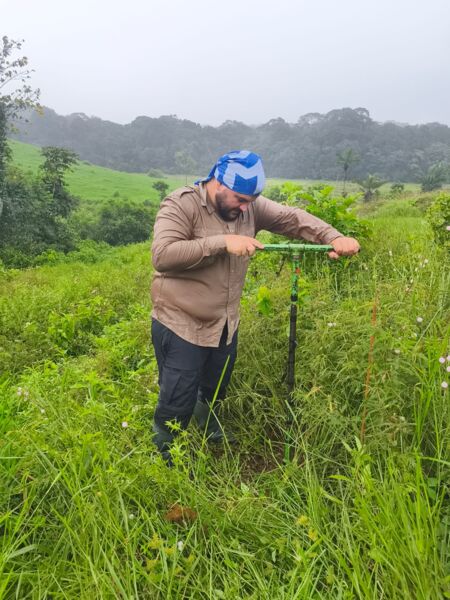
Louis Decline
- Agricultural engineer supporting the measurement of atmospheric gas fluxes in grassland (flux tower)
- 5 weeks / 1 month
- Source: CIRAD-SELMET, KOUROU Agricultural Campus
- Destination: INRAE-UREP, Crouel site, UMR HydroSciences Montpellier (UM-CNRS-IRD)
- Links with FairCarboN: Theme 1: Land–coastal zone–atmosphere continuum / Project / RIFT / ALAMOD
Summary of the mission
RIFT Scientific Mobility: Exploratory and statistical analysis of flow data: acquisition of technical and practical skills (tools and methods) from partners and the manufacturer, and application of these to the initial data collected in French Guiana.
I am applying for the FairCarboN 2026 international mobility scheme as I would like to take advantage of this opportunity to continue my training in flow-through tower systems and to work once again with our colleagues in mainland France. I will be in charge of the grassland flow-through tower located in French Guiana, which forms part of the RIFT project, until 2028.
In January 2025, shortly after taking up my post, I spent six days working alongside our colleagues at the UREP Clermont-Ferrand (INRAE), who specialise in flux towers in grazed grassland ecosystems. This visit enabled me to gain an understanding of the challenges involved in flux towers and the measurement of atmospheric GHG fluxes. I received training on flow towers, including their configuration, the assembly of a tower, the nature of the data collected (turbulence fluxes) and how the various pieces of equipment (sensors) complement one another.
My mobility project comprises three parts:
Part 1: Introduction to and training in the eddy covariance method by scientific experts
The order for the flux tower in French Guiana was placed entirely with LI-COR. This company offers a range of analytical instruments and software specialising in the eddy covariance method, which is the most precise and accurate method for measuring ecosystem fluxes. LI-COR systems are widely used around the world and have been cited in over 9,000 scientific publications.
Several times a year, LI-COR offers free training courses (basic and advanced) delivered by scientists specialising in their products (sensors, instruments, software) and their use in analysing GHG fluxes in ecosystems. The training course I have identified will take place in England in March 2026 and will run for three days, covering fundamental theory, equipment, software and data analysis. For me, this training course represents a real opportunity to expand my knowledge of how instruments work, and of data extraction, validation and analysis (post-processing, gap-filling, fluxes, balance, etc.).
Part 2: Practical training on data collected in French Guiana in collaboration with UREP
Having received training in the configuration and assembly of a wind tower from UREP staff prior to my appointment (January 2025), I would like to further my knowledge and put into practice, alongside them, the processing and analysis of the data. UREP uses the same type of sensors and software on its own grassland plots as those we have acquired. My time at UREP will enable me to refine my knowledge of how to use flux data analysis software and to apply it to the initial data collected by our flux tower in French Guiana. The visit will also provide an opportunity to re-examine the data collected between 2011 and 2019 by the flux tower previously installed on the same grassland plot. The review and validation of data prior to analysis will be one of the key aspects of the training. The dissemination of initial findings through an initial scientific publication will also be covered.
The analysis and interpretation of atmospheric fluxes in a grassland also rely on complementary analyses of soil parameters, aboveground and belowground biomass, and plant community composition. The site where the flow tower is located is also one of the pilot grassland plots in the French Guiana component of the ALAMOD project. This project focuses on the dynamics of carbon stocks in French Guiana’s soils. A wide range of parameters are measured: soil structure, texture and biochemical composition; soil carbon and nitrogen isotope content; microbial activity and soil macrofauna; plant species composition; above-ground and root biomass; and the management practices employed by livestock farmers on the plots. These data will enable a more accurate interpretation of atmospheric fluxes and a comprehensive analysis of the carbon budgets of the grassland under study. The UREP is the national reference unit for GHG emissions and biogeochemical modelling of grassland ecosystems. My time at the UREP will enable me to see how data on the spatio-temporal variation of soil carbon and vegetation cover are compared and interpreted alongside atmospheric flux data. These discussions will also enable us to address the specific characteristics of activities and measurements relating to a tropical environment.
Part 3: Strengthening partnerships and collaborative links
I would like to spend a week working with another team in France that specialises in flow-through systems. This week, I will be hosted at the UMR HydroSciences Montpellier (UM-CNRS-IRD) by Chloé OLLIVIER, Principal Investigator of Rift’s Working Group 1. I will have the opportunity to visit the three flux stations in the Montpellier region belonging to the OZCAR (Ceyrac site) and ICOS (Puechabon and Fontblanche sites) networks, which form part of the collaboration between the RIFT and Drought ForC projects, funded by FairCarboN.
This visit will give me the opportunity to exchange ideas and discuss with the scientific teams a different approach to measuring atmospheric fluxes, in other ecosystems such as Mediterranean forest environments, and in relation to different issues (energy and water transfers at the surface-atmosphere interface). This will give me the opportunity to explore the application of the Eddy Covariance method to continental and Mediterranean ecosystems, to discover a different way of processing atmospheric flux data, and to strengthen and diversify partnerships and collaborative links, in conjunction with the RIFT network. Here in French Guiana, our aim is to integrate our study site into scientific networks (including ICOS). Visiting three study sites that have been part of scientific networks for many years will give me the opportunity to gather feedback on their expectations and requirements, the workload involved, and the benefits this brings to the study site.
Added value
In French Guiana, there are no training courses in flux data analysis. The ECOFOG Joint Research Unit (UMR) in French Guiana, with which we collaborate on the RIFT project, has been managing a flux tower installed in a natural forest in Paracou since 2003. Towers in forests and grasslands differ in several respects (vegetation cover, footprint area, layout and number of sensors, flux analyses and different supplementary data). Furthermore, we do not have the same equipment as our colleagues in French Guiana, nor do we use the same software. The geographical distance from our colleagues in mainland France and French Guiana’s isolation mean that we are dependent on the expertise of, and communication with, our colleagues at UREP. In this context, the high-level training provided by experts from LI-COR, together with the experience and expertise of our colleagues at UREP regarding flux emissions from herbaceous vegetation, represent the added value of the project for us. Mobility will enable: (i) High-level training and skills development, from both a technical and practical perspective, covering knowledge of equipment, data management (post-processing, gap-filling), data analysis and utilisation, and the generation of flux data at different time scales. (ii) The acquisition of the autonomy that is essential for our team in the context of French Guiana.
This mobility programme will also help to strengthen collaborative links with our colleagues at UREP and to initiate technical and scientific exchanges with other research teams (UMR Hydrosciences Montpellier) working on atmospheric fluxes in agroecosystems, focusing in particular on issues relating to the specific characteristics of temperate zones. Ultimately, the aim is to become self-sufficient and capable of carrying out these analyses on a routine basis, so as to become a point of reference for the scientific community in a region where this technology is not widely available. As our equipment is state-of-the-art, we are helping to raise awareness of new equipment, software and analytical methods through exchanges with the scientific community working on GHG fluxes.
Translated with DeepL.com (free version)
Keywords: Global change/Greenhouse gas sources, transport and storage/Atmospheric fluxes of C and CH₄/Flux tower/Tropical ecosystems/Training/Collaboration/Autonomy/Data management, analysis and utilisation/Global budgets/Temporal trends/Forest-grassland conversion